




Revision – Elizabethan religion. Revision and exam board materials (OCR Y107 Later Tudors)

All,

Following on from today’s session please find the attached materials.

Exam board Scheme of Work

sow


Two useful board screen shots

rel aimsElizabeth’s religious aims (remember that it is always easier to argue that Elizabeth was, as S.Doran suggested “a committed and conventionally pious protestant” who got the religious settlement that she wanted).


rel overviewAn overview of the topic and key issues. Note, the comparison of the Catholic and Puritan threats might look like a too large topic for a 35 minutes exam question. However, have a look at the chief examiner’s comments below. They could be taken as “two issues” in their own right.


Useful exam board materials

Below is the chief examiner’s generic comments in 2019 for those students who did well in their Tudor essays.

  • Discussed at least two issues in depth.
  • Gave supporting detail that was both accurate and relevant to the question set, not just the topic.
  • Reached a supported judgement about the issue in the question.
  • Made a series of interim judgements about the issues discussed in relation to the question.

Our comparison of similar questions

(with x2 ten minute podcasts discussing them)

Rel 1


Rel 2


Marking tasks and essay plans

(if you want them)

Mark these two essays – which is better? Why?

I hope that there is something helpful here.

One final point I forgot in the session. Know your Archbishops of Canterbury. Dickens and Fellows is very helpful here (pages 177 – 179). This is Jasmine’s version of the table on p179

Mr Kydd.


Posted in Revision, The Later Tudors | Comments Off on Revision – Elizabethan religion. Revision and exam board materials (OCR Y107 Later Tudors)

Enrichment – something to discuss. Do school textbooks whitewash history?

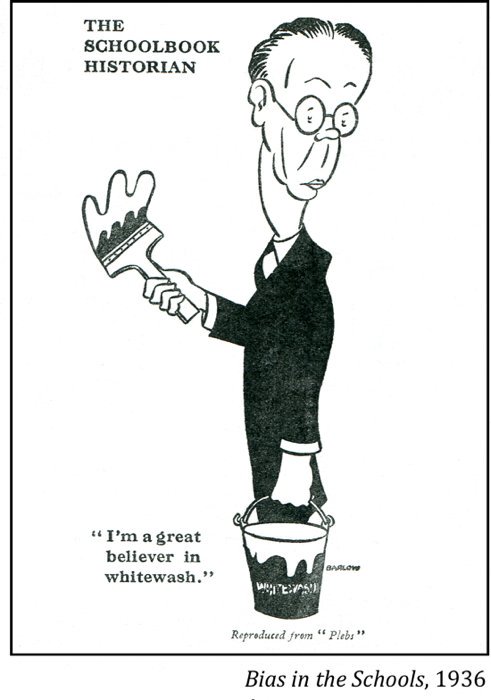
schoolbook historianNo school subject is more contentious than history. This is because of its link to politics and how we view ourselves. The last politician to really try to impose his view on school history was Michael Gove in Coalition Government (2010 – 2015).  Equally, Jeremy Corbyn has suggested that schools should teach more about the role and legacy of the British Empire.

Yet, despite political interference, in British schools history departments are currently broadly free to teach what they want, in the way they want, using the materials that they want (the one exception is that we are required to teach the Holocaust). Underpinning all this of course are the questions – what is the role of history in the curriculum / who should decide what is taught? There is nothing new in this. The image on the left reflects a view as early as 1936 that schools history was whitewashed.

It might not surprise you that I have archived  old textbooks. They show a shocking change in how issues such as the British Empire, the abolition of slavery and the causes of First World War have been  presented over the last hundred years. A thread that runs through them is the omission of Irish history.

What is taught, what is omitted, and what materials are used is ever-changing. Something for us to discuss (carefully) in History Society.

Mr Kydd.

Posted in Enrichment, History Society | Comments Off on Enrichment – something to discuss. Do school textbooks whitewash history?

Who should I vote for?

polling-stationAll,

I guess that you are likely to be more IT-wise than me (not saying much I know), but please be careful if you use multi-choice election quizzes to help you decide who to vote for.  They are a great tool, but I have discovered that some are clearly put out by activists to guide you to their party (or more often away from their main rival). That said, the following two sites seem be helpful.

  1. The following BBC site always you to compare the parties policies on issues that matter to you. It is deliberately written in neutral language, and does not tell you who to vote for.
  2. I have tried the Who should I vote for site with different answers, and it seems to give the full range of parties. It seems fine.

Above all, please do register to vote. It takes 5 minutes. but the deadline is the 26th November.

Mr Kydd.

Posted in Politics | Comments Off on Who should I vote for?

Enrichment – something to discuss in History Society: – Starkey on Remembrance

eAIKQoNIAll,

If you click here you will get to the Daily Mail’s reporting of David Starkey’s suggestion that  Remembrance Sunday has become a ‘crazy religious ritual’ in which people had to prove they were thinking of the war dead.

Two things are very predictable here;

  1. David Starkey has a long track record of deliberately saying controversial things (click here for example for a discussion an earlier history society had about his comments on the 2011 riots – that was heated).
  2. The Daily Mail was always going to be outraged.

I am posting this not to make a judgement Starkey’s views (you can do that for yourselves), but rather to reflect on the question – why should we care what Starkey thinks? Why should we seek the views of a man who is after all an Early Modern specialist any more than any other academic ? We might also like to ask if quoting twitter responses is what journalism looks like in 2019?

Two questions.

  1. Is Starkey right?
  2. What does this latest Starkey spat (or indeed any other you care to pick) say about the role of the historian is the age of celebrity?

Have a think.

Mr Kydd.

Posted in Enrichment, History Society | 1 Comment

IGCSE enrichment – Nazi election / propaganda posters

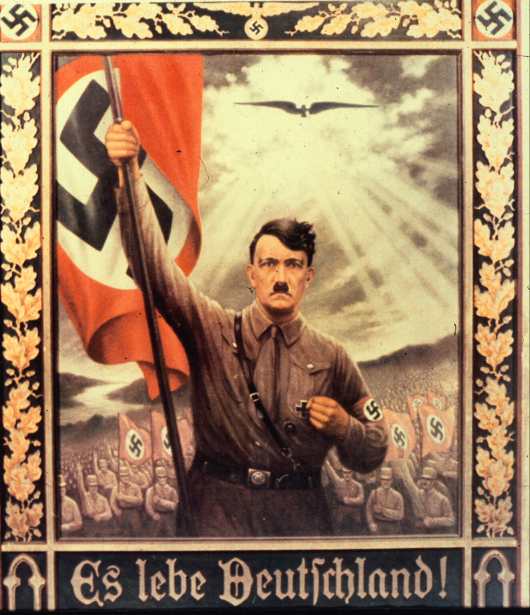
doveFollowing on from today’s lesson, have a look at this collection of Nazi propaganda poster (upto 1933). Later posters can be found here (1933 – 1939) and here (1939 – 1945). The first page is most useful to us at this stage. Note how different groups are targeted with different messages.

Mr Kydd.

Posted in Germany Kaiser to Furhrer course | Comments Off on IGCSE enrichment – Nazi election / propaganda posters

Enrichment – something to read – The fall of the Berlin Wall

BerlinAll,

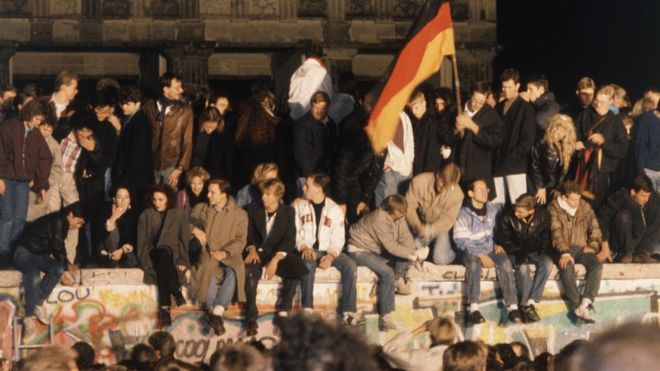
I hope that you had a chance over the weekend to see some of the reporting on the 30th anniversary of the fall of the Berlin Wall. I was your age when it fell, and it was a time of great hope. If you have missed it, the BBC really did well here, and the following links might help you.

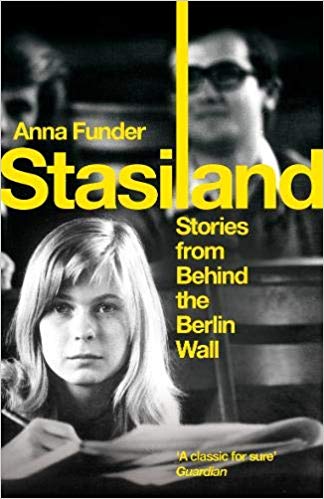
These are all very much worth a look. However, might I suggest that you read the excellent Stalisland by Anna Funder (just £2.00 on Amazon).  The review below neatly sums up a remarkable book.

“In 1989, the Berlin Wall fell; shortly afterwards the two Germanies reunited, and East stalislandGermany ceased to exist. In a country where the headquarters of the secret police can become a museum literally overnight, and one in 50 East Germans were informing on their countrymen and women, there are a thousand stories just waiting to get out. Anna Funder tells extraordinary tales from the underbelly of the former East Germany – she meets Miriam, who as a 16-year-old might have started World War III, visits the man who painted the line which became the Berlin Wall and gets drunk with the legendary ‘Mik Jegger’ of the East, once declared by the authorities to his face to ‘no longer to exist’. Written with wit and literary flair, Stasiland provides a rivetting insight into life behind the wall.”

Enjoy,

Mr Kydd


Posted in Enrichment | Comments Off on Enrichment – something to read – The fall of the Berlin Wall

Know the Standard evening – what does an A* look like in history?

bad-presentation1All,

Many thanks for coming on Thursday. I that there was something that was helpful for you. Click here for the electronic version of my presentation.

Mr Kydd.

Posted in Site News | Comments Off on Know the Standard evening – what does an A* look like in history?

Enrichment – something to read – ancient scrolls charred by Vesuvius could be read once again

3500If you click here you will get to a lovely article in The Guardian, discussing how 2,000 year-old scrolls may now be read. It is a perfect example of how history remains an ever-evolving subject.

“When Mount Vesuvius erupted in AD79 it destroyed the towns of Pompeii and Herculaneum, their inhabitants and their prized possessions – among them a fine library of scrolls that were carbonised by the searing heat of ash and gas.

But scientists say there may still be hope that the fragile documents can once more be read thanks to an innovative approach involving high-energy x-rays and artificial intelligence.

The two unopened scrolls that will be probed belong to the Institut de France in Paris and are part of an astonishing collection of about 1,800 scrolls that was first discovered in 1752 during excavations of Herculaneum. Together they make up the only known intact library from antiquity, with the majority of the collection now preserved in a museum in Naples.”

Mr Kydd.

Posted in Enrichment, history in the news | Comments Off on Enrichment – something to read – ancient scrolls charred by Vesuvius could be read once again

iGCSE enrichment – something to watch – The People’s Century – On the line

Year Ten,

Following on from the snippet that we saw in the lesson on Fordism and the moving assembly line, the whole episode from the People’s Century project. This series tried to tell the history of the Twentieth Century in the words of the people who lived through it.

Posted in Enrichment, IGCSE | Comments Off on iGCSE enrichment – something to watch – The People’s Century – On the line

Enrichment – History in the news’ – Renia’s diary – discovered after 70 years.

3657If you click here and here you will get to two news reports about the diary of Renia Spiegel. She was an eighteen year old Polish Jew who found herself caught up in the Holocaust. She hoped to become a poet, and it is a heart-breaking read. She describes falling in love for the first time with a boy, and they shared their first kiss just hours before the Nazis reached her home town. She was shot dead in July 1942 at the age of 18 by German soldiers who discovered her hiding in the attic of a house after she had escaped from the ghetto.

Below is her diary entry for 7th June 1942.

Wherever I look, there is bloodshed. Such terrible pogroms. There is killing, murdering. God Almighty, for the umpteenth time I humble myself in front of you, help us, save us! Lord God, let us live, I beg You, I want to live! I’ve experienced so little of life. I don’t want to die. I’m scared of death. It’s all so stupid, so petty, so unimportant, so small. Today I’m worried about being ugly; tomorrow I might stop thinking forever.

Mr Kydd.

Posted in Enrichment, history in the news | Comments Off on Enrichment – History in the news’ – Renia’s diary – discovered after 70 years.