Obituary – Eva Kor

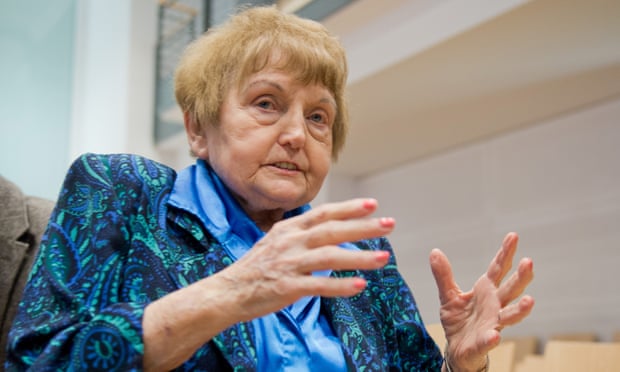
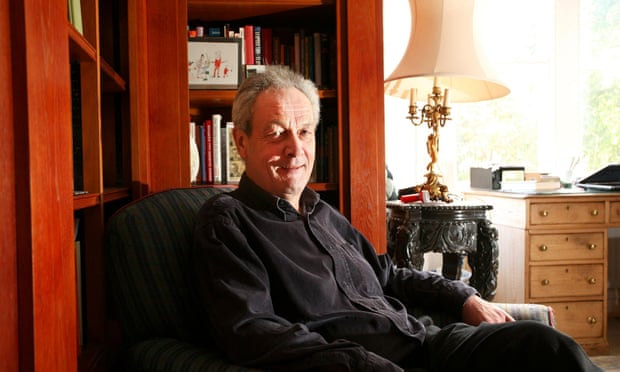
3424If you click here you will get to The Guardian’s obituary for the remarkable Eva Kor. She was the victim of Joseph Mengele at Auschwitz, who became a forgiveness advocate, deadicting her life to Holocaust awareness. She testified in 2015 trial of SS officer Oskar Groening. Below she explains the importance of forgiveness, and in the video, discusses her experiences in the camp.

For us historians, her passing raises the question of how we address Holocaust denial when it finally passes from living memory.

“Forgive your worst enemies,” Kor said in a video recording of her last visit to the Auschwitz Museum. “The moment I forgave the Nazis, I felt free from Auschwitz and from all the tragedy that had occurred to me,” she added.

Posted in Obituaries | Comments Off on Obituary – Eva Kor

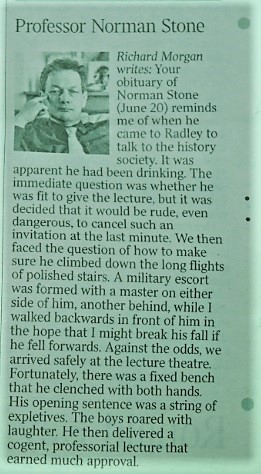
Enrichment – obituary Norman Stone – perhaps the rudest historian…

stoneIf you click here you will get to The Guardian’s review to Margret Thatcher’s favourite historian – Norman Stone. Right-wing, undoubtedly brilliant, his survey texts were perhaps his real strength. I have also included one of his last lectures below. He was also one of that line of historians who got himself into many rows with his peers.

His books can be found here.

“At a time when malice and rudeness were highly prized by some right-wing Cambridge dons, Stone outdid them all in the abuse he hurled at anyone he disapproved of, including feminists (“rancid”), Oxford dons (“a dreadful collection of deadbeats, dead wood and has-beens”), students (“smelly and inattentive”), David Cameron and John Major (“transitional nobodies”), Edward Heath (“a flabby-faced coward”) and many more.

Stone was undoubtedly clever. He could write entertainingly and could summarise complex historical circumstances in a few pregnant sentences, gifts which brought him a flourishing career as a journalist and commentator. He was a talented linguist who read and spoke more than half a dozen languages, including Hungarian. Yet his career was also dogged by character flaws that prevented him from fulfilling his early promise as a historian.”

Have a read and see what you think.

Mr Kydd.

Posted in Enrichment, historians, Obituaries | Comments Off on Enrichment – obituary Norman Stone – perhaps the rudest historian…

Enrichment – Understanding the significance of D Day. Something to read, watch and listen to.

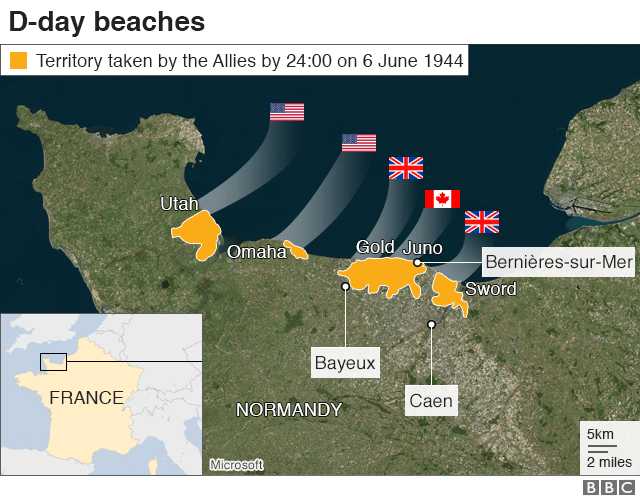
_107227180_d_day_beaches_v2_640-ncThere have been so many moving articles written to mark the 75th anniversary of D Day it is hard to know where to start. The following BBC interviews with  survivors might be as good a good place as any. Below is a brief interview with Colette Marin-Catherine. She was 16-years-old when the Allies landed on 6th June 1944. She was one of the volunteers at Bayeux Military Hospital who helped with the 14,000 civilians killed or wounded by the bombings.

Perhaps what D Day meant to the oppressed of Nazi-occupied Europe can be best understood by reading Anne Frank’s reaction. She wrote “my dearest Kitty. This is D-Day, the BBC announced at 12. This is the day. The invasion has begun. Is this really the beginning of the long-awaited liberation?” 

You can listen to this for yourself in this BBC Radio programme.

Mr Kydd.

Posted in Enrichment, history in the news | Comments Off on Enrichment – Understanding the significance of D Day. Something to read, watch and listen to.

Enrichment – IGCSE – something to think about – Roe V Wade today

roe v wadeAll,

There are few more sensitive issues than abortion, and I certainly do not see it as my job to tell you what to think about it.

However, as we study Roe V Wade in 1973 as part of our work on the Divided Union (USA 1945 – 1975) course it is notable how contentious the issue remains today in the USA. Below are three links that explain what  is presently happening in Alabama.

Mr Kydd

Posted in Enrichment, IGCSE | Comments Off on Enrichment – IGCSE – something to think about – Roe V Wade today

Enrichment – IGCSE – Who was Rosie the riveter?

We_Can_Do_It-375x485If you click here, you will an article exploring the identity of the famous Rosie the Riveter. It is well worth a read – not least for the insight the casual sexism of the caption next to Naomi Parker. This at least helps us to understand the frustrations of women like Betty Friedan.


“For years, people believed that a Michigan woman named Geraldine Hoff Doyle was the model for the poster. Doyle, who had worked briefly as a metal presser in a factory in 1942, saw a photograph of a bandanna-clad woman working at an industrial lathe reprinted in a magazine in the 1980s, and identified the woman as her younger self; she later linked this photo to Miller’s famous poster. By the 1990s, media reports were identifying Doyle as the “real-life Rosie the Riveter,” a claim that was widely repeated for years, including in 

Doyle’s obituary in 2010.

But Kimble wasn’t so sure. “How do we know that?” he says of his initial reaction to reading that Doyle was the woman in the image that (supposedly) inspired Miller’s poster. “Everything else we think we know about that poster is dubious. How do we know about her?”

Though he already knew the artist had no descendants, and had left limited papers behind, with no clue of who his model might have been, Kimble began looking into the 1942 photograph. And after five years of searching, he found “the smoking gun,” as he calls it—a copy of the photograph with the original caption glued on the back. Dated March 1942 at the Naval Air Station in Alameda, it identified “Pretty Naomi Parker” as the woman at the lathe.

Here is the original caption, which speaks volumes about how women working in factories during the war were seen:

“Pretty Naomi Parker is as easy to look at as overtime pay on the week’s check. And she’s a good example of an old contention that glamor is what goes into the clothes, and not the clothes. Pre-war fashion frills are only a discord in war-time clothing for women. Naomi wears heavy shoes, black suit, and a turban to keep her hair out of harm’s way (we mean the machine, you dope).”

Naomi Parker, more famously known as Rosie the Riveter, working in heels at the Alameda Naval Air station during WWII.

Posted in Enrichment, History Society, IGCSE, Photography | Comments Off on Enrichment – IGCSE – Who was Rosie the riveter?

Enrichment – what was the Tudor sweating sickness?

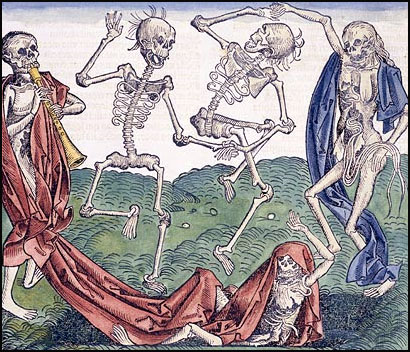
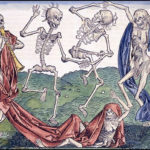
dancedeathFollowing on from today’s lesson, the following pages help us understand what the English Sweat or the Sweating Sickness was.

Click here for a description of it.

“The disease began very suddenly with a sense of apprehension, followed by cold shivers (sometimes very violent), giddiness, headache and severe pains in the neck, shoulders and limbs, with great prostration. After the cold stage, which might last from half-an-hour to three hours, followed the stage of heat and sweating. The characteristic sweat broke out suddenly, and, as it seemed to those accustomed to the disease, without any obvious cause. With the sweat, or after that was poured out, came a sense of heat, and with this headache and delirium, rapid pulse and intense thirst. Palpitation and pain in the heart were frequent symptoms. No eruption of any kind on the skin was generally observed; In the later stages there was either general prostration and collapse, or an irresistible tendency to sleep, which was thought to be fatal if the patient were permitted to give way to it. The malady was remarkably rapid in its course, being sometimes fatal even in two or three hours, and some patients died in less than that time. More commonly it was protracted to a period of twelve to twenty-four hours, beyond which it rarely lasted. Those who survived for twenty-four hours were considered safe.”

Click here for a possible identification of it today.

“Then in 1993, an outbreak of a remarkably similar syndrome occurred among the Navajo people in the region of Gallup, New Mexico. This episode, known as the Four Corners outbreak after the region of south-western USA in which it was located, turned the attention of sweating sickness investigators towards its causative agent: Sin Nombre virus. Sin Nombre is a hantavirus, a member of a group of viruses that were mostly previously known in Europe for causing a kidney failure syndrome, and a cousin of several tropical fever viruses transmitted by biting insects. The new disease was given the name hantavirus pulmonary syndrome (HPS).”

Click here for a possible discussion of why it died out.

“Sweating sickness had disappeared by late Elizabethan times. Its reign of terror barely lasted a century. If indeed it was an ancient variant of HPS, we can perhaps speculate about what led to its demise. The virus may have mutated to a less virulent form, perhaps in the process acquiring the capacity to be passed between humans as a more benign feverish illness, rather than being just a sporadic environmental hazard. Or perhaps its evolutionary trajectory took it in the other direction, becoming more fatal to its rodent hosts, thereby reducing the quantity of infected droppings around human habitations.”

Mr Kydd.

Posted in Enrichment, History Society, The Later Tudors | Comments Off on Enrichment – what was the Tudor sweating sickness?

Enrichment – something to listen to – historians in discussion. #VersusHistory

640x640_13252590If you click here you will get to the excellent #VersusHistory website to hear historians discuss and debate. Upper Sixth historians should click here to get to a very sharp podcast analysis of Soviet industrial policy.

Mr Kydd.

Posted in Enrichment, historians | Comments Off on Enrichment – something to listen to – historians in discussion. #VersusHistory

Obituary: John Lukacs, iconoclastic historian who wrote a best-selling tribute to Churchill

merlin_154518483_447f3686-3418-43cc-ae83-d029b1620505-articleLargeIf you click here you will get to a Scotsman obituary for the Hungarian historian John Lukacs. Perhaps his most famous work was his tribute to Winston Churchill – “Blood, Toil, Tears and Sweat”. I always remember him for being one of the first to call out David Irving.

He is perhaps most interesting to us, because he prided himself on his intellectual independence, as the extract below reflects. Whether you agree with his views or not, this rejection of the consensus was clearly a healthy thing for a historian.

“He considered himself a “reactionary,” a mourner for the “civilisation and culture of the past 500 years, European and Western.” He saw decline in the worship of technological progress, the elevation of science to religion, and the rise of materialism. Drawing openly upon Alexis de Tocqueville’s warnings about a “tyranny of the majority”, Lukacs was especially wary of populism and was quoted by other historians as Donald Trump rose to the presidency. Lukacs feared that the public was too easily manipulated into committing terrible crimes.

“The kind of populist nationalism that Hitler incarnated has been and continues to be the most deadly of modern plagues,” he once wrote. He belonged to few academic or political organizations and was unafraid to challenge his peers, whether Arthur M Schlesinger Jr, Hannah Arendt or British historian David Irving. In The Hitler of History, published in 1997, Lukacs alleged that Irving was sympathetic to the Nazis, leading to threats of legal action from Irving and the removal of passages from the book in England. In recent years, Irving has been widely condemned because of his ties to Holocaust deniers.”

Have a read and see what you think.

Mr Kydd.

Posted in historians, Obituaries | Comments Off on Obituary: John Lukacs, iconoclastic historian who wrote a best-selling tribute to Churchill

Enrichment – Later Tudors – something to read – Rival Queens – Kate Williams (University of Reading)

coverIf you click here you can read a review of “Rival Queens” by Professor Williams in The Herald. The book suggests “that story needs re-tuning”, and would be excellent summer reading for Year Twelve historians.

“Mary crossed the Solway Firth to England in the hope her cousin Elizabeth I would help restore her to the Scottish throne, but instead Mary was kept a prisoner and eventually executed. It’s a story that has produced two of the strongest images in the history of these islands: Elizabeth as regina triumphant, the woman with the heart and stomach of a king, and Mary as the tragic sovereign, duped by men and unsupported by the woman she turned to for help.”

Below Professor Williams discusses her motivations for writing the book. I have a copy if anyone wants to borrow it.

Mr Kydd.

Posted in Enrichment, history in the news | Comments Off on Enrichment – Later Tudors – something to read – Rival Queens – Kate Williams (University of Reading)

Enrichment – something to listen to / discuss – Strange Fruit – the most shocking song of all time?

If you click here you will get to an excellent BBC article on Strange Fruit by Billie Holiday. It was recorded 80 years ago today. Have a look and see what you think.

On 20 April 1939, the jazz singer Billie Holiday stepped into a studio with an eight-piece band to record Strange Fruit. This jarring song about the horrors of lynching was not only Holiday’s biggest hit, but it would become one of the most influential protest songs of the 20th Century – continuing to speak to us about racial violence today.

It was named the song of the century by Time magazine in 1999, and the story of Strange Fruit’s conception has entered legend. Originally a poem called Bitter Fruit, it was written by the Jewish school teacher Abel Meeropol under the pseudonym Lewis Allen in response to lynching in US southern states. “I wrote Strange Fruit because I hate lynching, and I hate injustice, and I hate the people who perpetuate it,” Meeropol said in 1971.

Posted in Enrichment, history in the news | Comments Off on Enrichment – something to listen to / discuss – Strange Fruit – the most shocking song of all time?