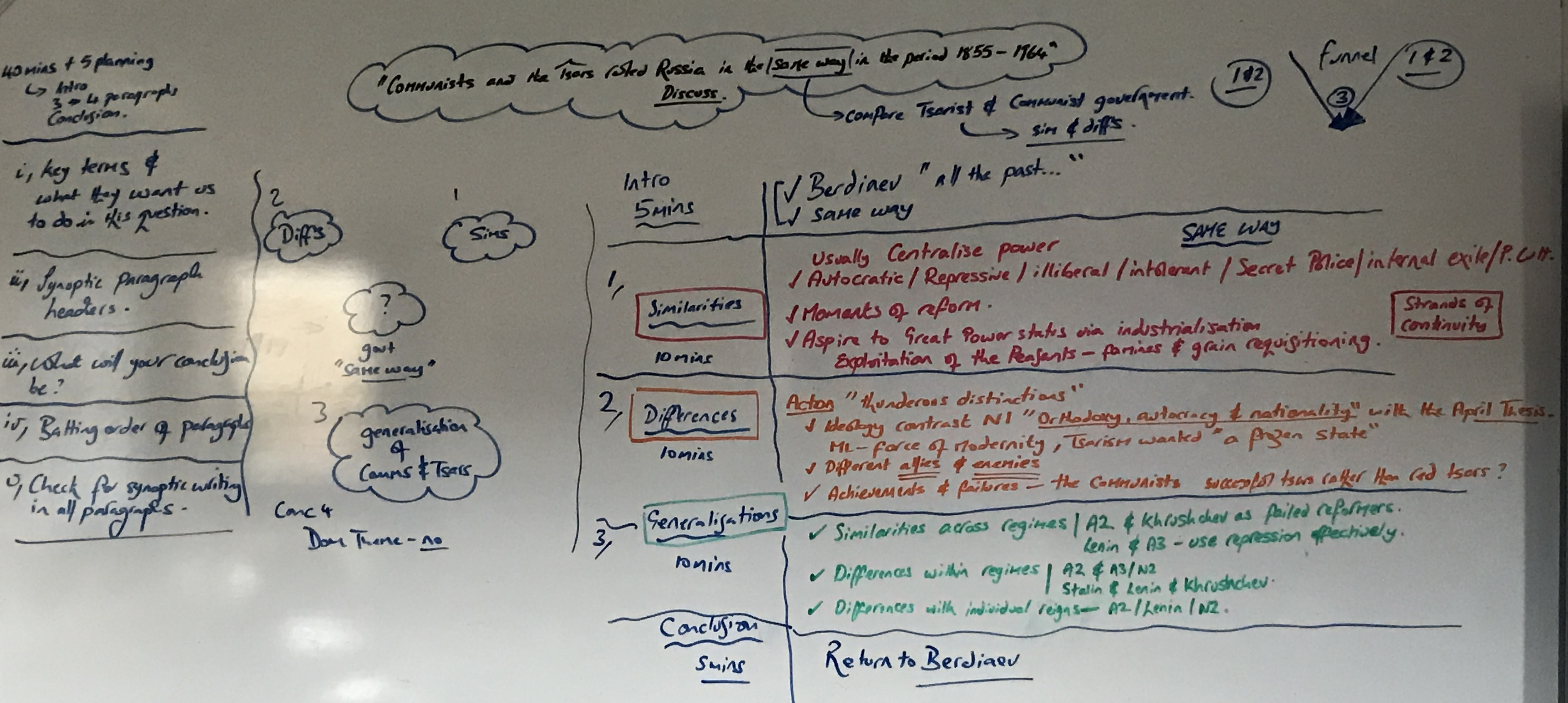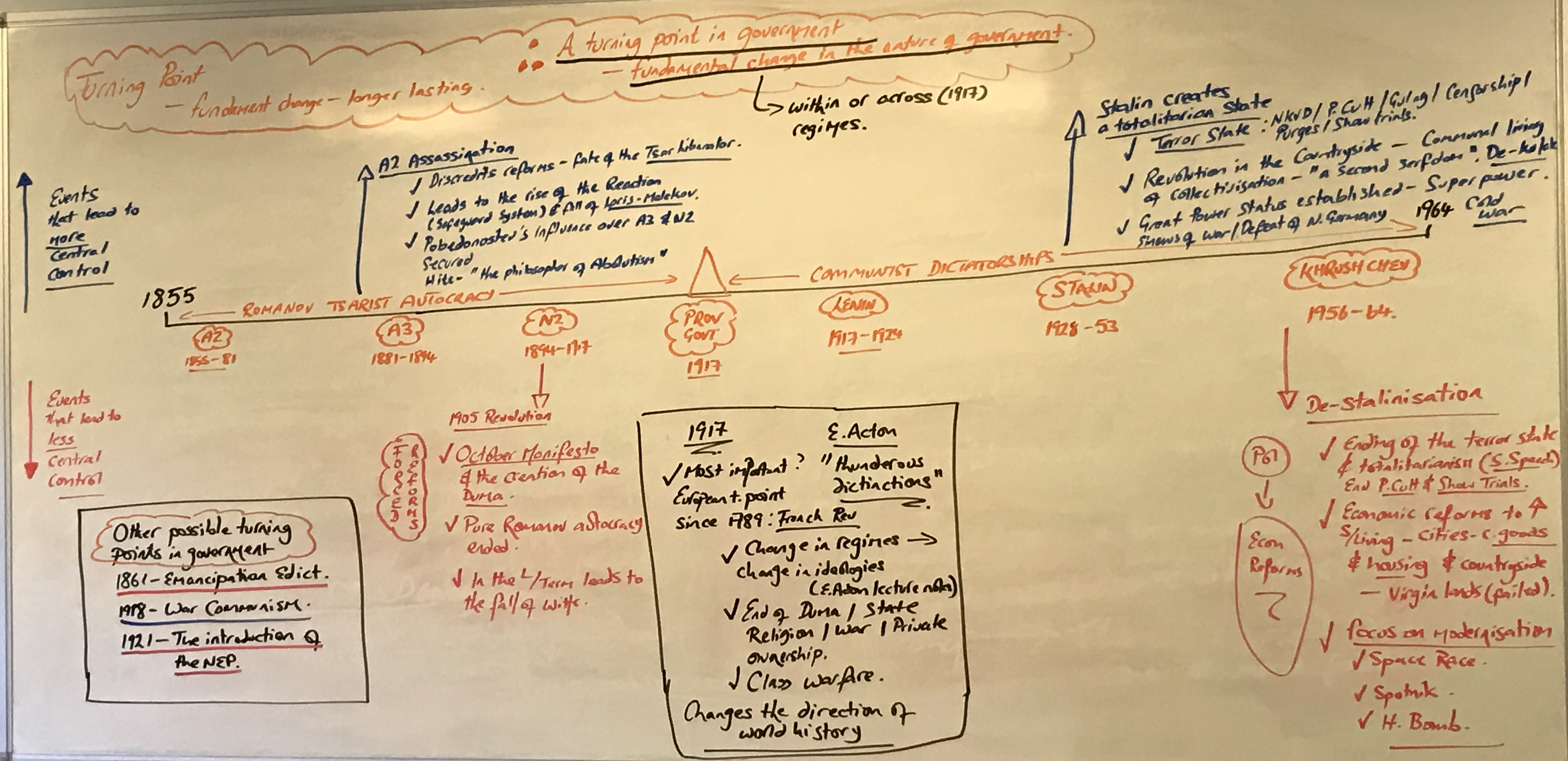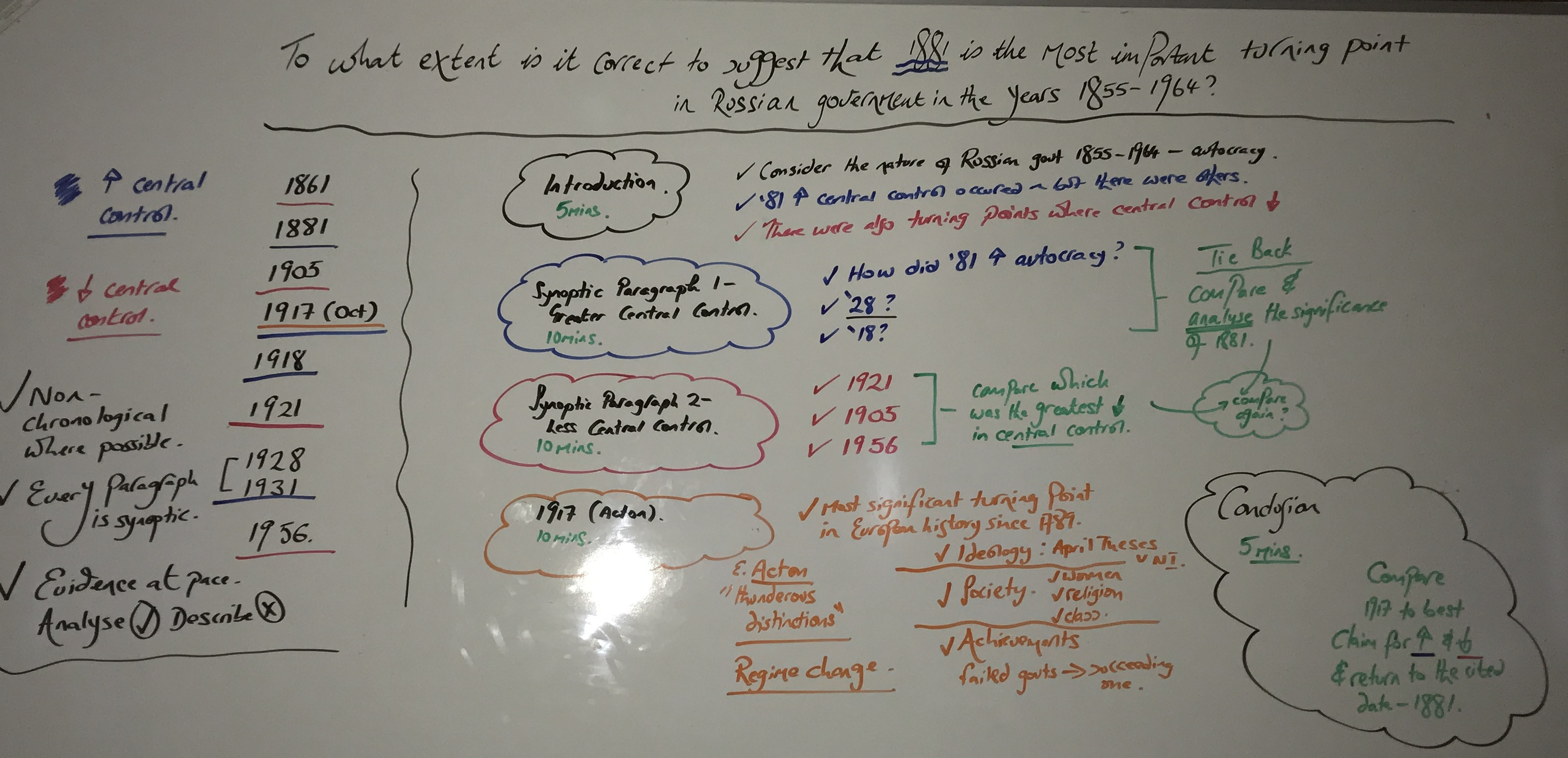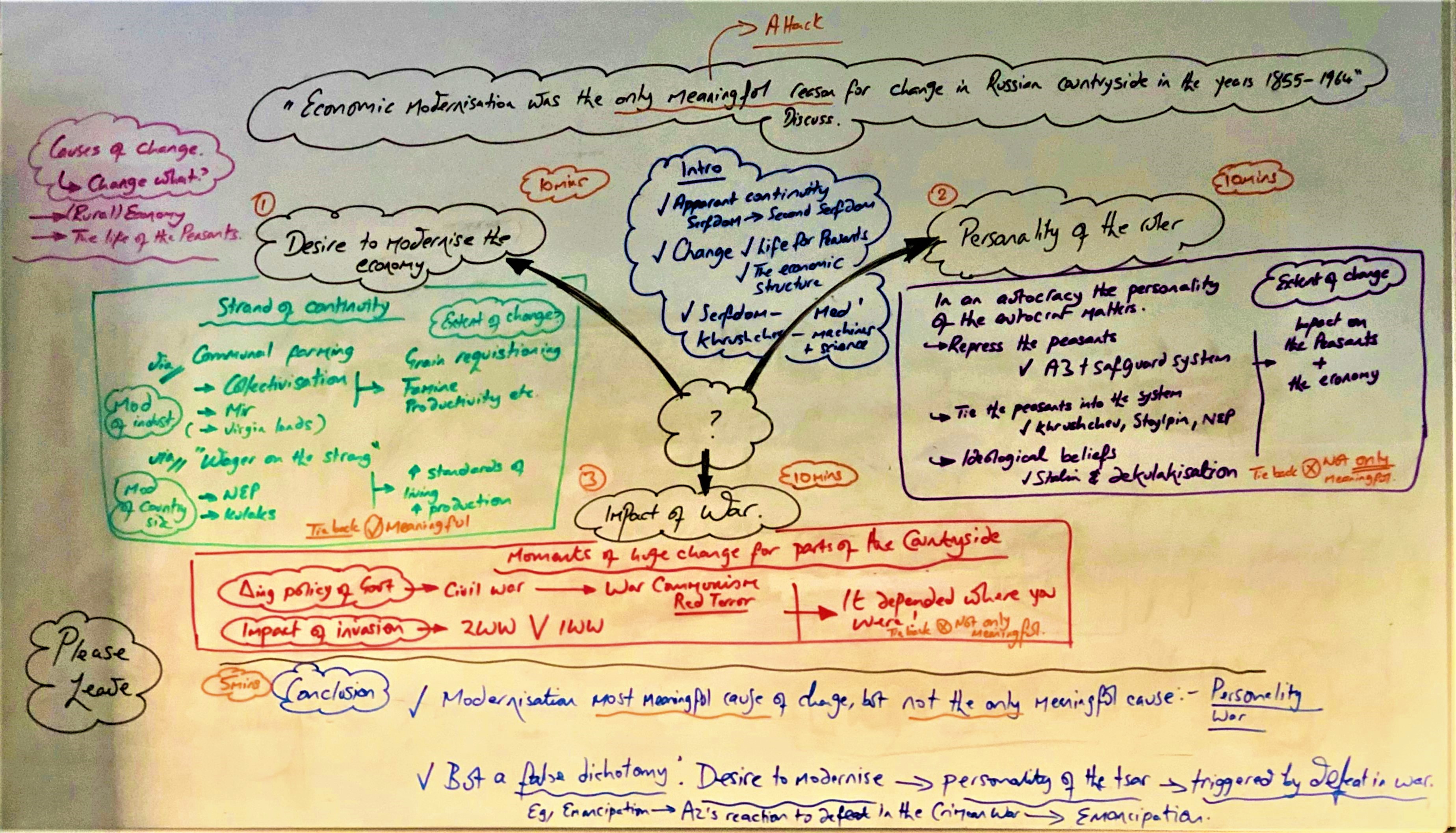
Welcome to the Russian dictatorships section of the site.

Those of you who used the old site will know it as predominantly a vehicle to discuss Russian history. These pages are designed to support Little Heath A2 students studying for their summer examination. Our examination board is OCR, and the paper is Historical Themes – Option B: Modern 1789 – 1997. The paper code is F966/02, and we are studying Russia from 1855 to 1964.

As before, we envisage that different students will use different parts of the site in different ways. Most students find the schemes of work and assessment sections above as particualrly useful for reference. You should however also look at the additional materials section. This has lots in it to support and extend your studies. Look for example at the excellent quotation bank from a previous student. Below this post will be articles of news about Russian History. You will also see posts here that will be used for online discussion homeworks where we will want you to add (ideally constructive) comments.

Above all however, we want this to be your site. However you use it is fine, but please take ownership of it.

 Mr Kydd

(akydd@littleheath.w-berks.sch.uk)

Oh and just for old times sake, here are two top historians (Mr Podesta and me circa 2030 ?) debating the Sevastopol mutiny of 1905 - perhaps…

YouTube Preview Image

Please find here the department’s 5Rs document (Research, Reflect, Review, Read around, and Respond to feedback). It sets out what A Levels students should expect from us, and what we expect from you.

Finally,  this is a complete list of all the past questions from the new course. However, students are reminded thar the latest Ofqual pronouncements on examinations which instructed the boards that;

  • All parts of the course must be examined.
  • No question should be (exactly) repeated.

You class teacher will discuss what this means for your revision with you. Perhaps more useful in essay planning is this revision work booklet.

Mr Kydd.
Posted in Uncategorized | Leave a comment

Industrialisation and Condition of the Workers – Feedback

Exclaimation mark - YellowAll,

Many thanks for all your hard work – please find below Tom’s detailed feedback. You should spend some time reflecting on his analysis. There are points here to consider for next week’s essay. 

The bad news is that this does mean that Luke and the boys won. Pot plants to follow…

Abul:

The industrialisation line for the Tsarist period is too high. In particular, the level of industrialisation during the Great Spurt was not really comparable to that which would later occur under Stalin, but the lines are at similar levels. Industrialisation between the end of the war and Stalin’s first Five Year Plan was not linear either – War Communism didn’t little for industrialisation and while things did improve under the NEP, arguably this mainly benefited agriculture and was in place for too short a time to have a large impact on industry. I disagree that the level of industrialisation fell after the first Five Year Plan. While subsequent plans were not necessarily as successful, industrialisation remained at a high rate until the Second World War.

The suffering line suggests a decrease in suffering after 1918, but the policy of War Communism was actually very repressive. Conditions improve under the NEP (for example, the creation of NEPmen), and suffering only starts to increase relative to War Communism from around 1928. At this point it remains increasing and high until the end of the war, and decreases as you say.

Girls:

Similarly, I think the industrialisation line is too high for the pre-1917 period. The drop in industrialisation after the end of the war does not recover until the late 1920s, hence the line is much too high and steep between 1918 a 1928. The relative increase in industrialisation between 1928 and 1941 should be the biggest on the entire graph, but here is shown to actually decrease.

Suffering was no where near as high at the start of the period as on the graph and should be much lower, for example, than Vyshnegradsky’s man-made famine. As mentioned above, suffering should not be shown to decrease immediately after 1918, and remained high until at least 1922, when it did drop until 1928. Suffering between 1928 and 1932 is shown to decrease, when actually this period is when it really began to increase, in particular due to the famine of the early 1930s. It then should remain consistently high until reaching a peak in 1945.

Boys:

The industrialisation line is more accurate up until the Great Spurt, but I don’t think the drop off after it should be as marked as it is. The real decline came during the war, not really before. Activity was low in the immediate aftermath, although perhaps not quite as bad as at the start of the period. Like with the girls, the industrialisation line increases too rapidly in the 1920s, it should not begin to shoot up until 1928. The post-war decline was not so bad as to take them back to 1928 levels, and I would argue the line should be steeper in the post-war era as industrialisation focused to more socially useful goods such as consumer goods.

The suffering line I think is the most accurate, as it shows that suffering did increase after the war under War Communism, and also that the big increase came in the 1930s, before decreasing after the war. The gradually increasing suffering throughout the Tsarist period, with a jump under Vyshnegrasky I think is accurate.

I think that overall the Boys graph is the best, as it shows suffering most accurately. Of the comments here, Luke D’s is the best as he makes the point that despite some progress under Tsarism, the Great Spurt should not be shown as that high on the graph as not that much progress was made, and similarly that the relative level of suffering in the Tsarist period was much less than it would later be under Stalin.

A couple of general points:
-suffering is shown to decrease immediately after 1945, but arguably this only started to happen from 1953 at the end of Stalinism
-The major period of industrialisation was from 1928 until the outbreak of war. All of the graphs show industrialisation almost reaching a peak before 1928, but Russia didn’t recover to pre-war levels until almost that late. The biggest jump should come between 1928 and 1941.
-Similarly, owing to the Great Terror of 1936-8, suffering should be shown to jump during the mid 1930s (not decrease as the girls said!), although this is not directly related to industrialisation, it was arguably the biggest cause of suffering in the entire period.

Posted in Revision | Leave a comment

Industry and the Condition of the Workers – comparative work

As we have now written on both industry and the condition of the workers it felt appropriate to conclude by comparing the two. Below therefore are your three attempts to draw two timelines on the same page (blue is industrial progress and pink is level of suffering for the workers), followed by your written justifications of your ideas.

Remember the higher the position on the timeline the greater the industrial  activity / level of suffering. The key here of course is to look at relative positions within and across timelines.

Task – Study your peers’ timeline and comments. Post a reply. What do you agree and disagree with ? Make sure to explain your thoughts using evidence (that you interact with ?). 

Mr Kydd.

The Girls

Why we drew the industry line where we did


We started our line low for the reason that the Crimean war was the 1st instance showing how much Russian needed to industrialise. After the Emancipation edict, an internal market started to form, hence the reason our line rose. However, we didn’t rank overtly high, due to the fact that it would have only had a long-term effect and would have not been beneficiary for the short-term. We decided ‘The great Spurt’ was one of the first instances where Russia began to industrialise on an international level, leading to a heightening of line. However industrialisation rapidly decreased, plunging lowest in the 1918 treaty of Brest-Litovsk, where Russian lost 25% of its population; 25% of its industry and 80% of its coal industry. During Stalin’s second 5yr plan in 1935, the Russian industry grew to its highest point in the years of 1855-1964 – were the Russian economy was just equipped enough to defend themselves in war. Yet, in 1945 Russia’s industrialisation decreased due to the German invasion of Barbarossa . Ending our line with increase in Russia’s industrialisation due to the fact in the year of 1956 Russia was now publically classed as a super power, wining the space race. Examples of this is Russia’s launching of Sputnik in October 1953 – the first artificial earth satellite, and also the development of the Nuclear Bomb.


Why we drew the exploitation of the workers line where we did

Our view of the relationship between the two lines

The Boys

 Why we drew the industry line where we did

From 1860-1890 there was a focus on industrialisation after the realisation of Russia’s backwardness in the Crimean war. The foundations of modernisation were being laid, culminating in Witte’s great spurt, with the highlight being the development of the Trans-Siberian railway which linked Russia’s population to its vast natural resources. However the First World War was further evidence for Russia’s lack of industrialisation, and the devastation of war communism along with the loss of large industrial areas under the treaty of Brest Litovsk led to levels of industrialisation dropping to pre- emancipation levels. Lenin’s NEP introduced a mixed economy that allowed for prosperity.  As a result levels of industrialisation rapidly increased to pre-war levels. Russia reached its peak of industrial development under Stalin, as his unprecedented production output made Russia strong enough to defend herself from German invasion in the Great Patriotic War. Stalin transformed Russia from an agrarian country into a major industrial superpower. The Great Patriotic War had devastating effects on Russia including the loss of 36 million of her people. However the destruction was not as devastating industrially as that of the First World War due to the levels of industrialisation Stalin had achieved pre-war. When Khrushchev came to power in 1956 Russia was a major industrial superpower and was winning the space race. This was unquantifiable progress from the Russia that just 100 years previous had been humiliated in the Crimean War. 

Why we drew the exploitation of the workers line where we did

 With the lack of industrialisation pre 1855 most of the suffering occurred in agriculture and although there was exploitation of the serfs, everyone was at the same level. The graph starts so low because this early suffering was nothing in comparison to the suffering that occurred later. Under Vyshnegradskii’s policy of “export and go hungry” the amount of suffering increased, particularly in the 1891 famines. However post Witte, leading into war communism, there was a steady rise in suffering which runs parallel to the First World War. The reason for the sharp increase in suffering under War Communism, peaking in 1920-21 was due to the famines which led to the deaths of an estimated 15 million people. Under the NEP, private trade was once again allowed and peasants could once again sell their surplus crops for profit. This led to food production levels reaching pre-war levels once again. Acton calls this the “golden age” of the Russian peasant.  From then on however we see the unique exploitation of the workers under Stalin. This is why the line increases rapidly until it reaches the greatest amount of suffering in the period in 1945. The Soviet Union had been devastated in the Great Patriotic War, 36 million citizens had dies and 70,000 kolkhozy had been completely wiped out. The amount of suffering then begins to decline under Khrushchev. Khrushchev did ease some of the suffering of the workers through his Virgin Lands policy and the focus of consumer goods which led to an increase in standards of living and a decline in suffering.

Our view of the relationship between the two lines

 The main relationship between our two lines is that when industrialisation in Russia was increasing, so was the amount of suffering the workers experienced. This is shown by Witte’s Great Spurt in which Russia saw its first big industrial growth and made it the 5th largest industrial country in the world, but at the same time saw the suffering of the workers got worse and lead to the famine of 1891. As well as under Stalin’s five year plans when his unique amount of exploitation on the Russian workers lead to the biggest amount of industrialisation in the countries history, the amount of suffering for the workers  reached its absolute peak , and with the of the Second World War as well, saw the death of 36 million Soviet Citizens. The only real exception to this is when the industrialisation of Russia collapsed during the First World War and because of War Communism, the level of the suffering actually increased, which lead to the famine of 1920-21.

The other relationship between the two lines under the NEP and Krushchev is that when they are industrialising that actually do more to make things better for the working classes. For example, the NEP brought food production back to pre war levels and allowed the peasants to sell their surplus once more. Under Krushchev he increases industrialisation, but not at the expense of the proletariats and the peasants, he introduces a focus on consumer goods and increases living standards, as well as implementing his Virgin Lands policy in the countryside.

Abul

(who decided to make his own stand)

Why I drew my Industry line where I did / why I drew my exploitation of the workers line where I did

(done together)


Wittie and pre-Wittie, although saw for example saw for instances rapid railways construction and increasing exports, the suffering during this period reached a peak under Vyshengradskii’s grain export drives, were is thought to have killed 3 million. In his own words “we must export and go hungry” and go hungry they did. Any obstacle face by the tsars was faced with brutal force for example Lena goldfield massacre thought to have killed 200


Although Lenin came to power and in theory severing was meant to decline via his Sovnarkom decrees, the need to win a war led to the economic policy of war communism. This was a greater peak than Vyshengradskiis as it affected both the peasants and the proletariat and killed a greater number of people.


However the NEP success after war communism should not be underestimated as it is considered as the ‘golden age’. For him first time peasants had surplus grain to sell on. ‘Surplus’ is a key word as it signifies that peasants had more than they needed which is very rare in Russian history. Bu 1925 food production had reached pre-war level.


After Lenin’s death Stalin stated that Russia was “50 to 100 years behind the advanced countries”. He exploited the proletariat to an extent where there was 8 million Zeks in the gulags and whole class of kulaks where wiped out in the process of de-kulakastion. The suffering reached a peak during war famine due to collectivisation where it is thought to have killed 36 million soviets.      


After Stalin’s death Khrushchev de-nuances Stalin and quotes that “men feared there shadows” suggesting the unparallel levels of exploitation under Stalin. He put greater emphasise on consumer goods which incentives the peasants to increases productivity; furthermore his virgin lands policy greatly increased the amount of land under cultivation. This helped reduce exploitation.


My view of the relationship between the two lines


Industrialisation can be considered as proportional to exploration. Industrialisation was a strand of continuity and exploitation was a result of the need and want of rapid industrialisation. Under Reutern there was no real exploitation, the desire to industrialise was greater under Wittie and Vyshnegardskii who were intent on fulfilling great state projects e.g. trans-Siberian railway and drawing in foreign investment. The economic policies of Vyshnegradskii resulted famine which killed 3 million showing the proportional nature of exploitation and industrialisation.


Industrialisation was halted during war and greatly declined after it. Russia lost vast amounts of resources land, people and 80% of industry making both the peasants and proletariat suffer. War communism further increased the exploration. 


NEP and Khrushchev are unique figures as they increased both industrialisation and standard of living. NEP made a profit motive while Khrushchev incentives people with greater number of consumer goods.


Stalin can also be considered as a unique figure as the levels of industrialisation and exploration was unparallel to any other Russian ruler. In the 1930’s growth rate averaged 12-13% but was hampered by war and Stalin’s policies along with war left 36 million dead and more than 8 million were enslaved in the gulags. The peaks therefore are greatest under Stalin.     


Posted in Uncategorized | 9 Comments

Solzhenitsyn’s One Day: The book that shook the USSR

As this was set as part of your summer reading I thought it would be helpful to post this BBC review here. This review explains the origins and importance of the November 1962 book, suggesting that “it is now regarded as one of the most significant books of the 20th Century”. You may like to also read this article on Solzhenitsyn entitled A tortured patriot .

Perhaps we should leave the last word with the writer himself.

 “It was still dark, although a greenish light was brightening in the east. A thin, treacherous breeze was creeping in from the same direction. There is no worse moment than when you turn out for work parade in the morning. In the dark, in the freezing cold, with a hungry belly, and the whole day ahead of you. You lose the power of speech…”

Mr Kydd.

Posted in News | Leave a comment

Am I in proportion Year Thirteen ?

As we are now onthe brink of writing our first fully synoptic essays on the peasants I think it would be helpful to return to our agriculture timelines.

Task :- Have a look again at the timeline. Now that you understand this theme what do you think of it ? In pairs discuss it and post a comment below thinking carefully about the relative positions of the key events.  Make sure that you explain your reasons behind your comments.

Mr Kydd.

Posted in Uncategorized | 9 Comments

Coming in October…

…Fight club.

The plan is for an online History debate between Little Heath and Sir Henry Floyd. It will be done through posting comments to this post.

The aim is to get you really thinking about how to construct analytical and powerful arguments in as few words as possible.

The rules.

Obviously the first rule of Fight Club is that you do not talk about Fight Club. The second rule is also that you do not talk about fight club. However the third rule is that each school will get two posts of no more than 200 words. Credit will be given for the power of your arguments and evidence deployed (you should aim to interact with it where it is appropriate). 

The timeline will be as follows.

30th September – The title is released (Little Heath will argue for the motion and Sir Henry Floyd against it).

The week starting the 1st October – Little Heath have a week to make their first post in favour of the motion.

The week starting the 15th October – Sir Henry Floyd have a week to put their first post against the motion.

The week starting the 22nd October – both schools have a week to post a rebuttal of the other school’s argument.

Over half term – Judging to take place.

Enjoy…

Mr Kydd

DEBATE TITLE

To what extent is it correct to suggest that Alexander II deserves his reputation as the Tsar Liberator ?

Posted in Uncategorized | 6 Comments

Understanding Synoptic thinking – An example. Vladimir Putin stirs memories of Joseph Stalin as he urges ‘leap forward’

You might already have the idea that this course is about comparing and contrasting themes and ideas across the period 1855 to 1964. This is what we mean when we say we need to think synoptically. As such, we have just looked at serfdom. By the time we finish agriculture you need to be able to decide if you agree that Collectivisation under Stalin was “a second serfdom” (S Smith) or not.

This article from The Guardian reflects this.  The present ruler of Russia, Vladimir Putin, has called for industrial growth akin to Stalin’s in the 1930s. The quality and cost of this industrialisation is debated. However, it in turn is compared with Sergi Witte’s “Great Spurt” of the 1890s. Both focused on heavy industry (what Stalin would later call the “sinews of war”) , and both had great state projects (Witte ordered the building of the Trans-Siberian Railway whilst Stalin ordered the construction of the White Sea Canal and the Dnieper Dam. Both also averaged growth rates of about 8% per year, both centralised power and exploited the peasants.

You might think such similarities are overwhelming then. However, when we scratch below the surface, there are important differences as well. Witte’s industrialisation was a capitalist one (he placed Russia on the Gold Standard) whilst Stalin was a Marxist who aimed for ”Socialism in One Country” (and autarky). We might also want to refelct that Stalin was able to industrialise the USSR to an extent that it could (just) defend itself against German invasion in 1941. Witte’s industrialisation did not leave Romanov Russia in a position where it could fight effectively in 1914. We might also like to reflect upon the accuracy of Stalin’s figures (no-one could afford to miss their targets) and the levels of suffering that the two periods of rapid industrialisation caused the workers.

In other words, things that look the same in this course can sometimes mask significant differences.

Mr Kydd.

Posted in Uncategorized | Leave a comment

Pussy Riot – Russian History NOT quite repeating itself ?

There has been so much written about the Pussy Riot case that I am sure that you can make your own minds up about it. There is however an interesting interview in The Guardian with  Yekaterina Samutsevich. In it she   argues “more than anything, our trial showed the dependence of the justice system, and its direct authority, on Putin’s power, which clearly should not be the case in a government that calls itself democratic,”  The article then continues ”Pussy Riot and their supporters have accused Putin, and the powerful Russian Orthodox church, of orchestrating the case against them.”

If you accept this, then in the context of our course this is quite surprising. Yes, there is continuity in the use of repression from the centre. However, more interesting is Putin, with his KGB background, allied to what Marx called “the opiate of the masses” – the Orthodox Church.  The Church was seen as one of the “props” (Rogger) of Tsarism.

Perhaps the answer to this rapproachment lies in their common enemy, or rather what they perceive to be their common enemy of anarchism. After the launching of Operation Barbarossa in 1941, Churchill said of his new chum -Stalinist Russia “If Hitler invaded hell itself I would make at least a favourable reference to the devil in the House of Commons“. That marriage did not outlast the fall of the Nazi leader…

Mr Kydd.

Posted in News | 1 Comment

Pussy Riot trial ‘worse than Soviet era’

As you start this Year Thirteen course you may well have some idea that, as its title Russian dictatorships suggest, it wants you to think (and eventually write) in comparative terms.  

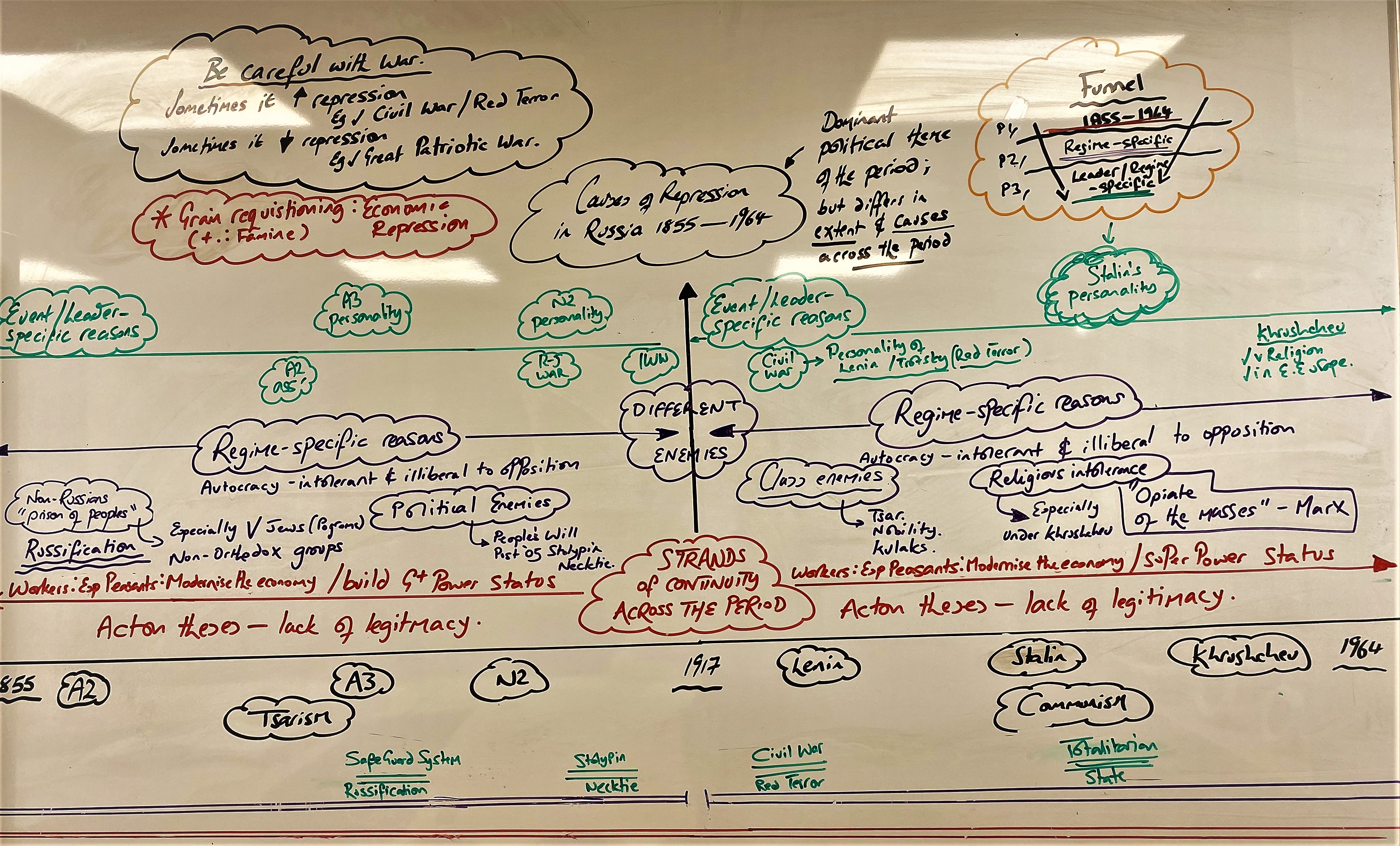
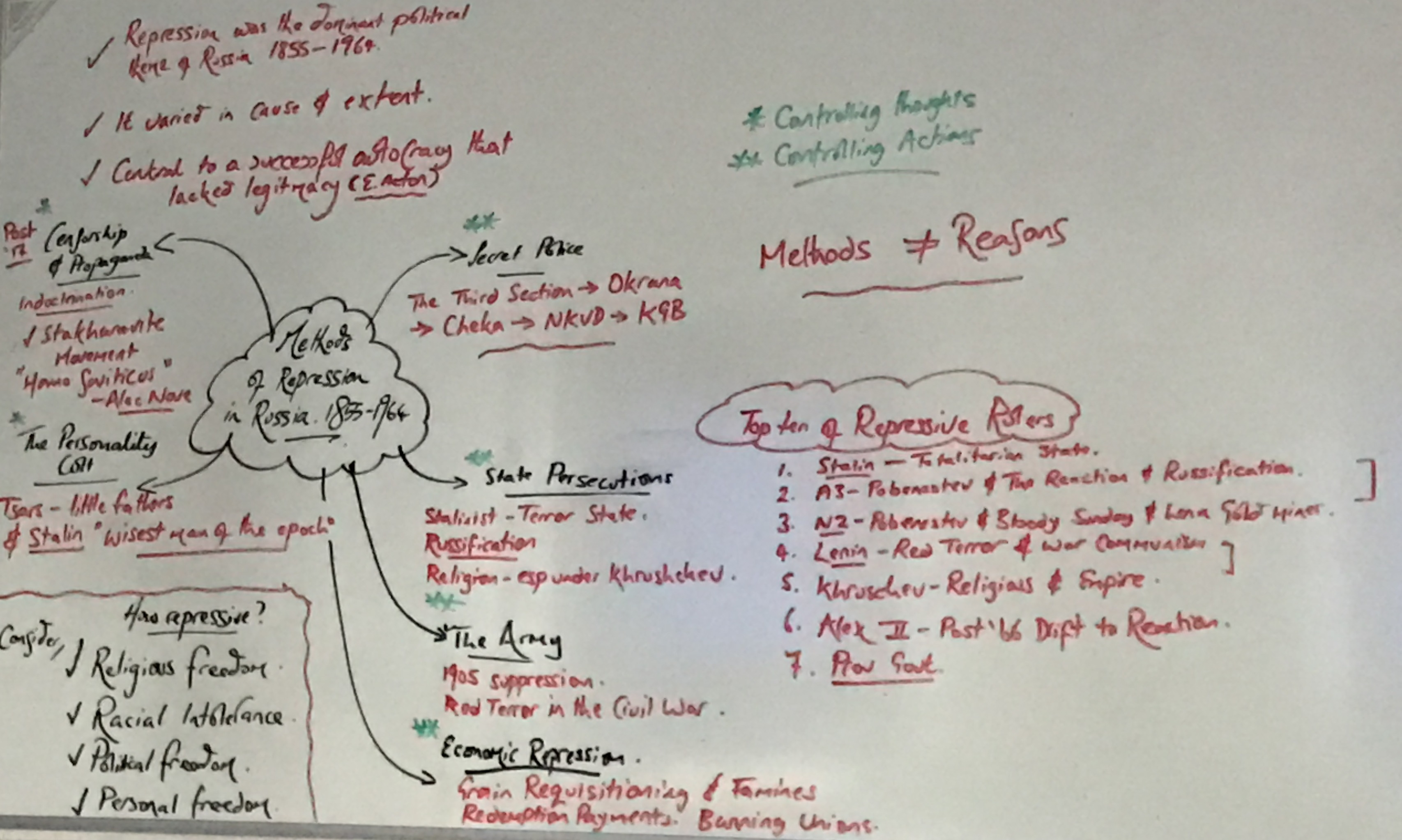
You may well also have an idea that repression and religion are dominant themes of the period 1855 to 1964. A central plank of both in the period is an intolerance of opposition to alternative views. Under Alexander III a policy of Russification was followed to force non-Orthodox subjects of the Tsar to convert, whilst in Stalin’s Russia repression was taken to a new scale in a totalitarian regime typified by show trials of the 1930s.

At present there is a trial underway of the three members of the band Pussy Riot, for performing a “punk prayer” against Putin in Moscow’s main cathedral. They are changed with hooliganism motivated by religious hatred, and could face ten years in jail. This article from Daily Telegraph suggests that  “the trio themselves claim they did not intend to upset Christians, but wanted to denounce Patriarch Kirill, the head of the Orthodox Church, for publicly supporting Mr Putin’s re-election. “It’s all about Putin taking personal offence,” said Nikolai Polozov, one of their lawyers. “He ordered this because you can’t insult the tsar.” You may like to read the article and follow the trial, See what you think, how valid are the parallels ?

Finally, I picked the Telegraph article because it quotes Masha Gessen. She wrote The Man Without a Face: The Unlikely Rise of Vladimir Putin (see the earlier post about an enrichment opportunity). Gessen argues “this is a show trial…all such prosecutions originate from the executive branch. Putin is a vengeful person, that’s the overriding factor.”

Mr Kydd.

Posted in News | 6 Comments

What are we reading over the Summer ?

One action that marks the successful step up to an A2 historian is the ability to undertake effective independent reading. This website is designed to help you with this. The teacher schemes of work have advised reading for students from Oxley before you come to the lesson. Equally the further reading section of the site has a coded library guide and supporting fiction.

We understand however that this is not something that you have been required to do all that much to date. As such, we thought it might be a good idea if we posted what we are going to read over the summer to support our Russia teaching.

Mr Kydd ~

I like to read something academic and something from Russian literature. I have nocticed that recent themed question have increasingly asked students to compare Tsarist and Communist society. As such I will be reading Edward Acton’s chapter entitled “State and Society under Lenin and Stalin” in Themes In Modern European History. Acton is one of my favourite historians to read as he combines pace and orginality without being too fussy. I picked a general reader because I understand the topic but want to deepen the evidence I have to deploy when I teach. I also intend to read Notes from Underground by Dostoevsky because it gives a personal insight into living on the fringes of an autocratic society (and because I have never managed to finish Crime and Punishment)


Posted in Uncategorized | 2 Comments

Stalin’s ‘deadly railway to nowhere’

This is a really interesting article on BBC news. It is about an unfinished railway built during Stalin’s rule.  You all know how important industrialisation and railway building was throughout the course and this is a good example of the human cost of this.  The article includes stories of some of the thousands of people sentenced to hard labour working on the railway. We can also link this to press and propaganda under Stalin as this railway has not been talked about for decades.

Posted in Uncategorized | 1 Comment